Greenland Resources
Mo money to be made

Disclosures, please read: I am long Greenland Resources. I may add or exit at any time without notice, and I will not update this piece. I have no affiliation with the company and receive no compensation from it or from anyone else. This piece was neither solicited nor reviewed by Greenland Resources. This is analysis, not advice. I am not a registered advisor and not a qualified person under NI 43-101. Resource, technical, and economic figures come from the company’s public disclosure, as well as my own independent calculations. The latter have not been independently reviewed. Forward-looking figures are estimates. All figures in USD unless noted. This piece was written by a human over ~15 hours, with AI used for research and proofreading assistance. Any errors are mine. Junior mining destroys capital as its base case. Act accordingly.
As there is yet to be a defining piece telling the story, I shall attempt that below. As always, I intend to write in a compressed yet meticulous way, yet I acknowledge in labouring to be concise, I become obscure.
Ruben (Chairman) Twitter here
Greenland Resources Feasibility Study here, Presentation here
Gist
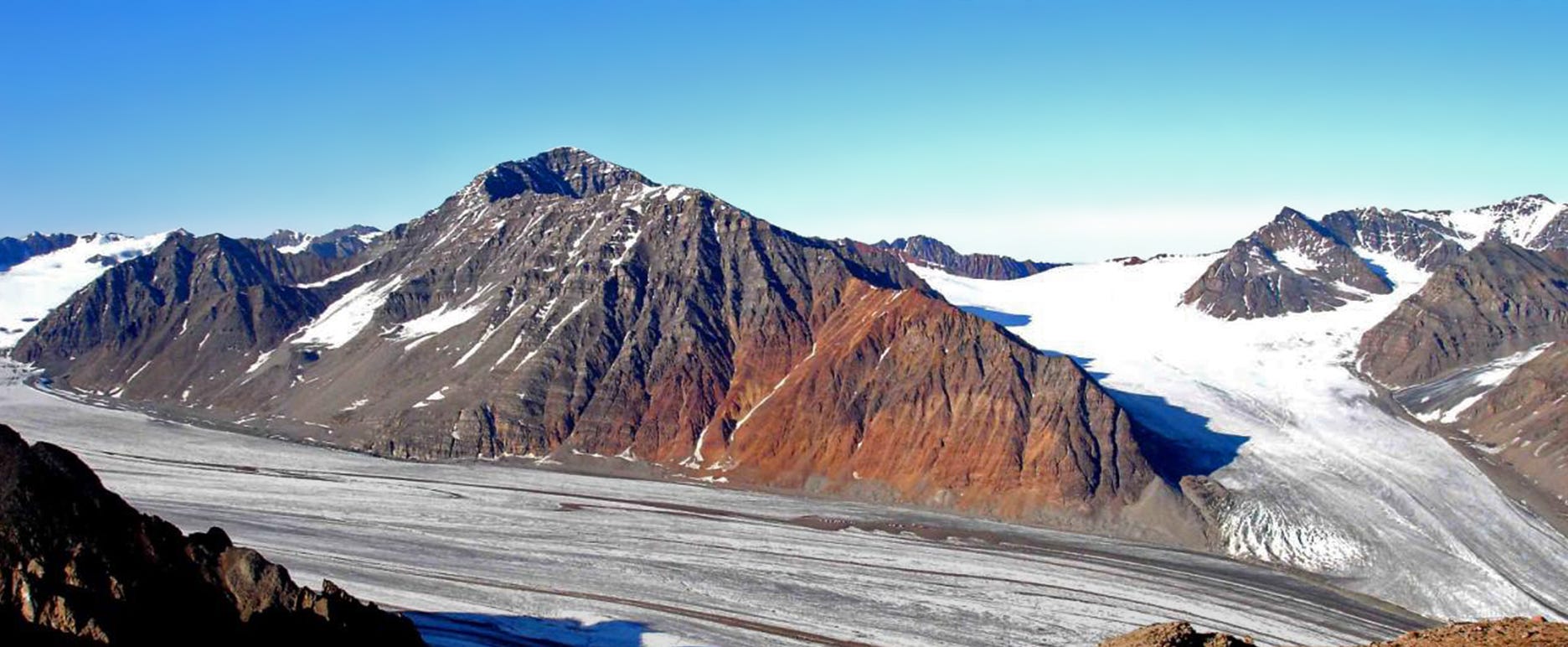
Greenland Resources owns 100% of Malmbjerg, a permitted, pre-construction-stage primary molybdenum deposit in central-east Greenland. It will be the first primary molybdenum mine built outside China in decades, in a commodity where the top four producing countries control roughly 90% of supply, where China holds export controls, and where Europe consumes more than anyone outside China while producing nothing.1 Malmbjerg will act as Europe’s strategic counterweight against Chinese supply dominance. Malmbjerg has a feasibility study, holds a 30-year exploitation license, and has received EU priority project status.2
Based on its 2022 DFS, Malmbjerg hosts 245 million tonnes at 0.17% MoS₂ containing 571 million pounds of molybdenum metal. The mine will be an open-pit operation with initial 20-year mine life. Its geology will allow its highest-grade zones (0.23% MoS₂) to be mined in the first decade, yielding an average of 32 Mlbs per year.
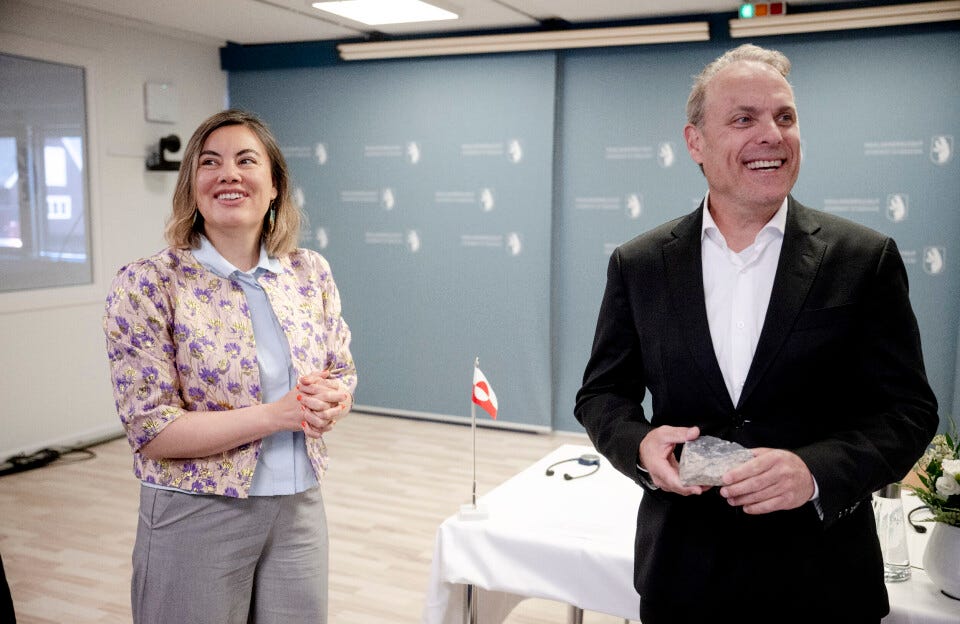
Nuuk, 19 June 2025: Minister Naaja Nathanielsen, and Greenland Resources Chair Dr. Ruben Shiffman, sign a 30-year exploitation license for the Malmbjerg molybdenum and magnesium project.
Mo?
Molybdenum (Mo) is not a household name, yet it is a critical material for modern industry. As a hard, silvery-white metal with an extremely high melting point, moly’s primary role is as an alloying agent in steel. Adding small percentages to steel greatly enhances strength, heat resistance and corrosion resistance. Moly has no 1-to-1 substitute. Everything from aerospace parts to military armour, wind turbines to oil pipelines relies on moly-strengthened steel. Europe consumes more Moly than anyone outside of China, yet has zero domestic production, creating a complete and highly vulnerable reliance on external imports.3
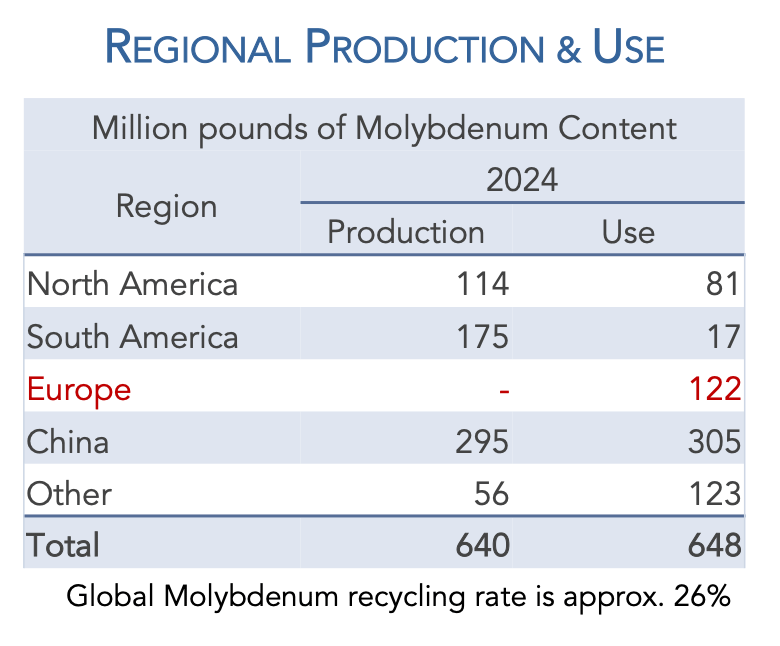
Molybdenum Production and Consumption by Region (2024)
Held Hostage
Those familiar with the potash industry know its concentration well: the top three producers control 70% of global output, enough to put agriculture ministers across the world into a panic from 2022. Molybdenum is worse. The top four, China, Chile, Peru and the USA, control ~90% of global production, China alone holding ~45%.4
The headline number understates the problem as not all moly is equal. The majority of global production (60%+) comes as a byproduct, mostly from copper porphyries. These systems are lower grade, carry more contamination, and are correspondingly less useful. Five of the seven primary molybdenum mines operating worldwide are in China. The other two are in Colorado.5
Byproduct moly runs 0.008% to 0.067% MoS₂, averaging around 0.030%. Primary deposit grades start above 0.10% MoS₂. Malmbjerg’s reserves are 245 million tonnes at 0.176% MoS₂, with the high-grade portion mined first: 0.23% MoS₂ across years one to ten.
Beyond grade, steel companies care about purity. Because byproduct molybdenum is floated off a copper circuit, it carries the residue of that process, and contamination is what disqualifies it from high-performance applications. Greenland Resources’ pitch to European buyers is a concentrate with very low impurity elements, suited to Europe’s high-performance steel and defence industries. That is one reason producers like SSAB and Outokumpu have signed binding off-takes. Supply security from a European jurisdiction matters, but so does the fact that the product is clean.6
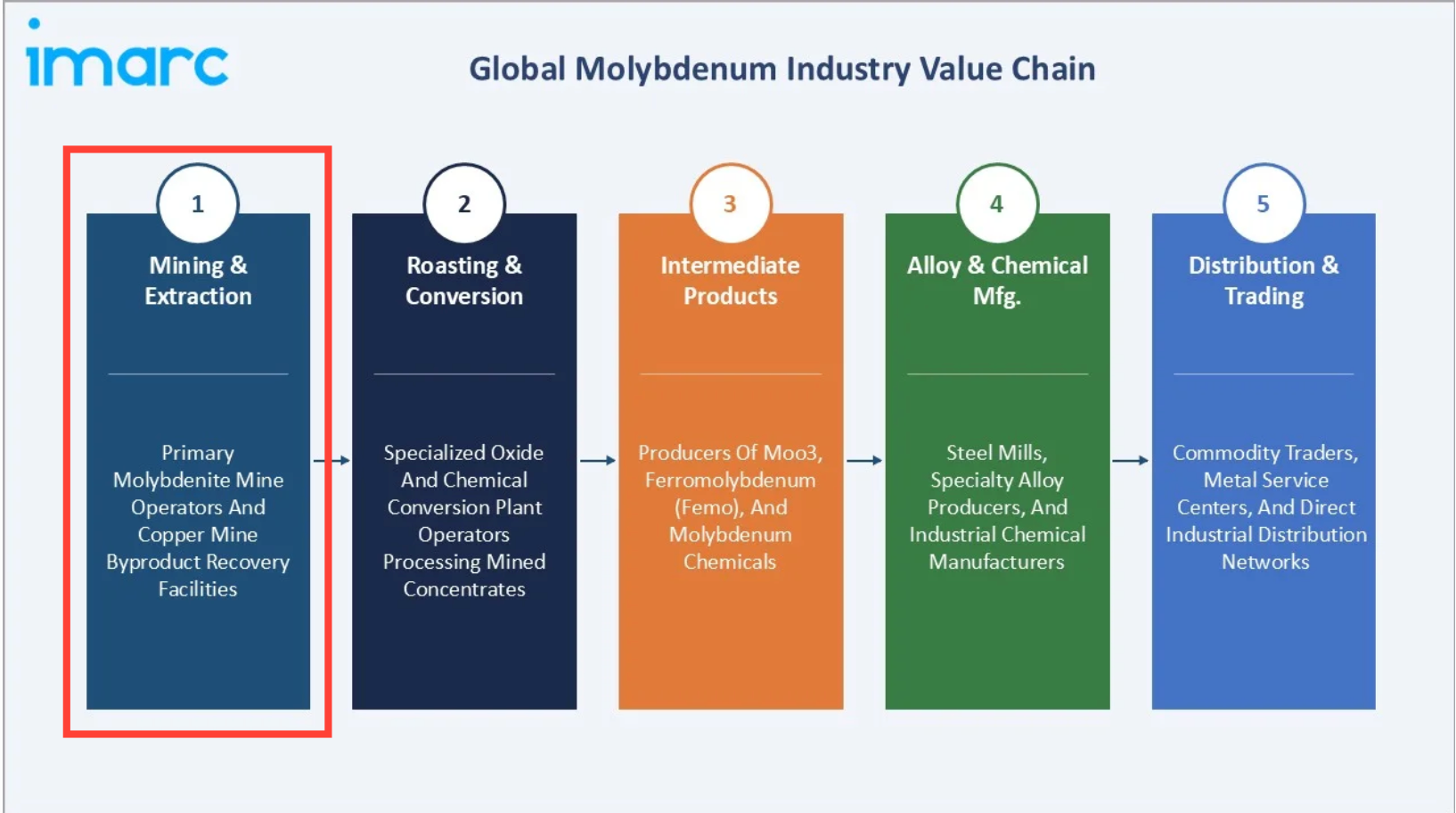
Europe already owns most of the chain: roasters, refiners, and the best specialty-steel and chemical manufacturers in the world. What it lacks is the first link. Malmbjerg closes a fully European value chain from ore to finished steel.
This reality got real in February 2025, when Beijing placed molybdenum under export control alongside tungsten, bismuth, indium and tellurium.7 European steel now takes what the CCP is willing to let leave the country. The alternative sits in Colorado, under an American administration that has made clear access to critical minerals is a matter for negotiation rather than assumption.
And Europe’s demand for that input is going up, not down. From TKMS’s submarines to Fincantieri’s warships to Rheinmetall’s tanks, the ReArm Europe build-out is a bill of materials and so far nobody has costed the raw inputs seriously.
For a long time both European companies and financiers knew this, but had no framework or mechanism to deploy it. Europe has historically not moved at speeds anything comparable to that of the USA and China, however that has begun to change.
Latecomer
There is no debate this is the issue in determining Europe's future economic power. They know it, and they are moving quickly now, however their starting point was far behind their competitors.
China: 25 Years
China has been at it the longest, financing and acquiring critical mineral assets around the world since the late 1990s through China Development Bank, Export-Import Bank, and the Belt and Road apparatus.
USA: 7 Years
The modern U.S. push is younger, dating to the 2019 creation of the Development Finance Corporation. The pivot accelerated in February 2021 when Joe Biden issued a directive to review all critical supply chains.
EU: 2 Years
The EU is the newest of the three to deploy dedicated instruments. Before 2024, most mineral projects were funded under climate programs. This changed in April 2024 when it passed its Critical Raw Materials Act (CRMA). This acts as the spine of the EU’s strategy to secure supply.
On December 3rd 2025, the EU adopted RESourceEU, the Commission's plan to accelerate the CRMA's implementation, committing to mobilize up to €3 billion over twelve months. The program mobilizes existing resources, coordinating with the European Investment Bank and member states through a financing hub. It can be thought of as a wrapper that tries to make the EU's scattered instruments point at the same priority projects at once. The EU's “vehicle” is a coordination layer assembled from parts that already existed, not a purpose-built financing engine like Canada Growth Fund.
On that same day, Greenland Resources was chosen along with Vulcan Energy’s lithium project as “priority investments” under the RESourceEU framework. These two were selected among a field of 44 applicants. Ruben has a working relationship with Commissioner Jozef Síkela, who has said about Malmbjerg:
“This project can meet all of Europe's defence needs for molybdenum and around a quarter of our total demand....it will create a fully European value chain and significantly reinforce our strategic autonomy,” adding on X that “we have recently unlocked financing for the Malmbjerg molybdenum project.”
Jozef Síkela, European Commissioner for International Partnerships
In April the company announced it had been accepted to the EIC STEP program (an actual funding instrument where the EIC takes direct equity stakes). The panel recommended €10 million from the EU’s fund, while the company lined up €40 million from two private investors to go in alongside, for €50 million total. The EIC equity should sit at the Danish holdco-level, Greenland Resources A/S. Terms remain undetermined on the precise ownership stake. It’s now waiting on the EIC Fund’s final approval, which is pending due diligence. This DD was on track to wrap up in late June, therefore a final decision is expected soon. If approved, this would mark the first time the EU has directly funded a mining project in Greenland. Because Greenland Resources sits in the opening wave of a brand-new program, Ruben and the team have had to navigate the complexities and hurdles that any new program will face.
I think the probability of Greenland Resources getting past the last stage of its current equity funding is on the order of 90%.
The single biggest point of failure in the EIC STEP scheme is the matching requirement, and Ruben has already secured firm commitments for the remaining €40 million. Secondly, the European Commission has explicitly designated Greenland Resources a high priority asset under RESourceEU. It appears unlikely the EIC diligence body rejects a company the broader Commission has publicly prioritized for continental security. Finally, the government of Canada recently signed off on its own grant, meaning an ally just wrapped its own rigorous due diligence process, adding to the report card that the corporate governance is clean.
When Greenland Resources accepts the EIC Fund equity stake, it will also be accepting sovereignty clawback clauses and veto rights over major structural changes. This ensures the project never falls into Chinese hands. Because the vast majority of Malmbjerg’s future molybdenum output is already legally promised to European industrial giants, there is no reason to prolong this. That said, as half of Brussels tends to be on a beach until September, I'd guess that’s when we'll hear something.
Just last week the EIB concluded a technical study on European exploration. The most useful line: “policy ambition currently runs ahead of the number of exploration projects that are ready to move towards development, largely because Europe has invested too little in exploration for many years.” The study concedes the obvious, the framework and the money outrun the current supply of real projects. Ruben was working through those lean early years, between when the asset was acquired in late-2017 and 2024, before the frameworks or the funding existed, now the company is reaping the benefits from it.
Locked
On the commercial side, Greenland Resources has all the off-takes they need, having signed both MOUs and binding off-takes with companies in Germany, Italy, Austria, Denmark, Belgium and Sweden. The largest of which is with the aforementioned Outokumpu (Finland), a $2 billion 10-year deal.8 All of their off-takes have price floors and ceilings built in, to protect both sides. This among other reasons is why I wouldn't suggest spending too much time thinking about Moly prices. Including thinking about Greenland Resources as an expression of the underlying commodity. Greenland Resources has never tracked the underlying commodity, and that is fine. It’s important to remember the share price only indicates what marginal buyers and sellers agree to on any given day (for any reason, often not $MOLY related).
Yes LME Moly spot prices are $32 today, up from the $18 used in its 2022 Feasibility Study. However pricing isn’t hugely important to the thesis, this is a primary input needed for the backbone of Europe’s industrial power. Do I think long-term Moly prices will be elevated? Yes. However moly could drift back down and the project would still be economic, prices could also move higher, it’s not something to track on the daily, and I know Ruben is too busy building to pay attention to the daily moves.
Malmbjerg’s cash cost of ~$8 per pound9 puts it in the first quartile (lowest 25%) of primary moly mines worldwide. With current spot prices, margins are beyond healthy, though exact price floors and ceilings the company has negotiated with its off-takers are confidential.
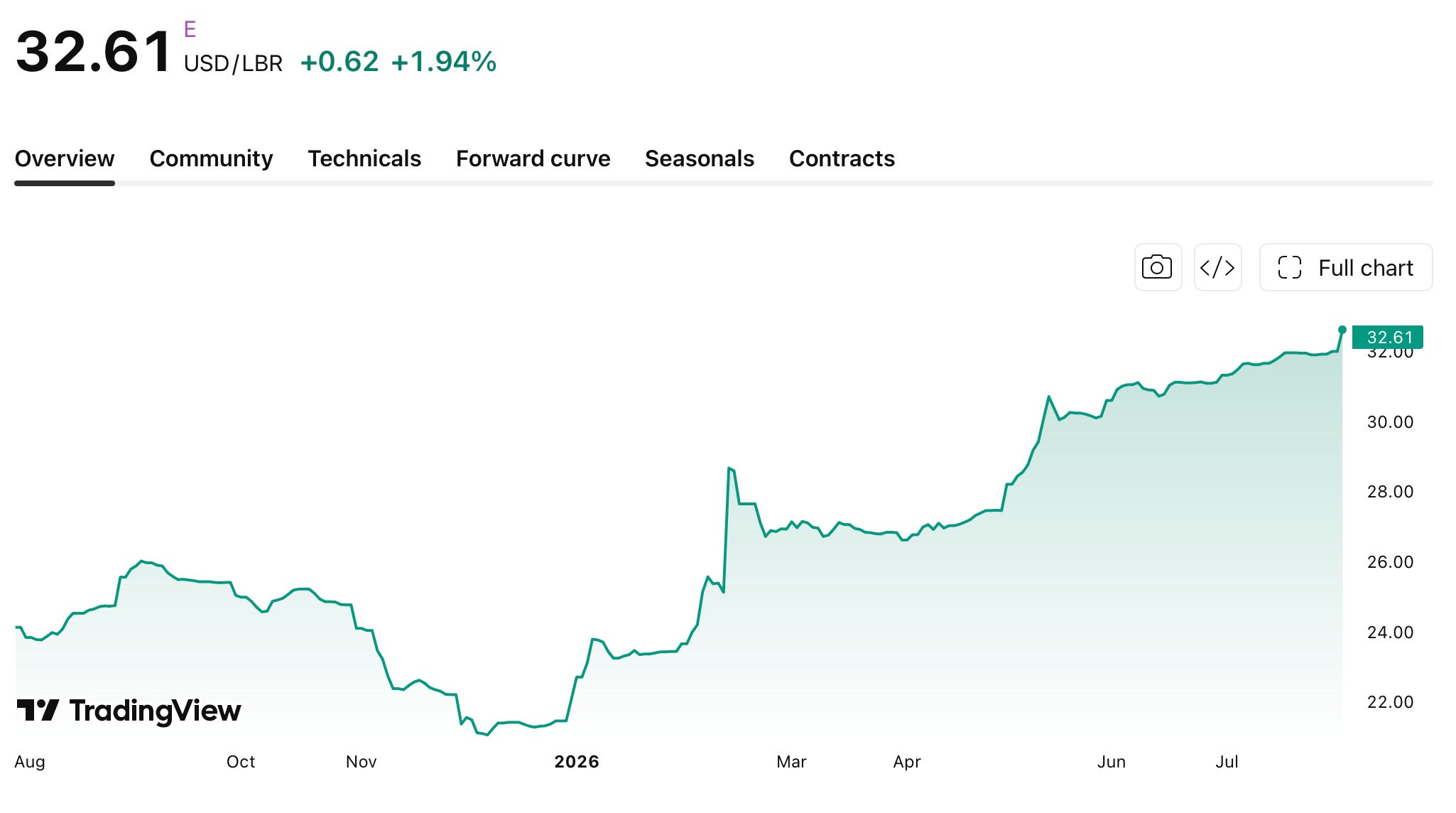
LME Molybdenum Futures (what Malmbjerg contracts are based on)
On financing, the project is backed by the export credit agencies (ECA) of Finland (Finnvera), Sweden (EKN), Denmark (EIFO) and Canada (EDC). Canada’s agreement is for up to a $275 million debt facility. Canada’s Minister of Natural Resources Tim Hodgson announced at PDAC this year that Greenland Resources was the recipient of a C$7M (non-repayable) grant through NRCan’s Critical Minerals Research program. This is the first G7 Country to support the project, as well as the first time Canada has made an investment in Greenland.
“By supporting innovative projects like those led by Greenland Resources, we are strengthening Canada’s leadership in technologies that reduce environmental impacts, improve productivity and build long‑term economic and security resilience.”
Tim Hodgson, Minister of Natural Resources
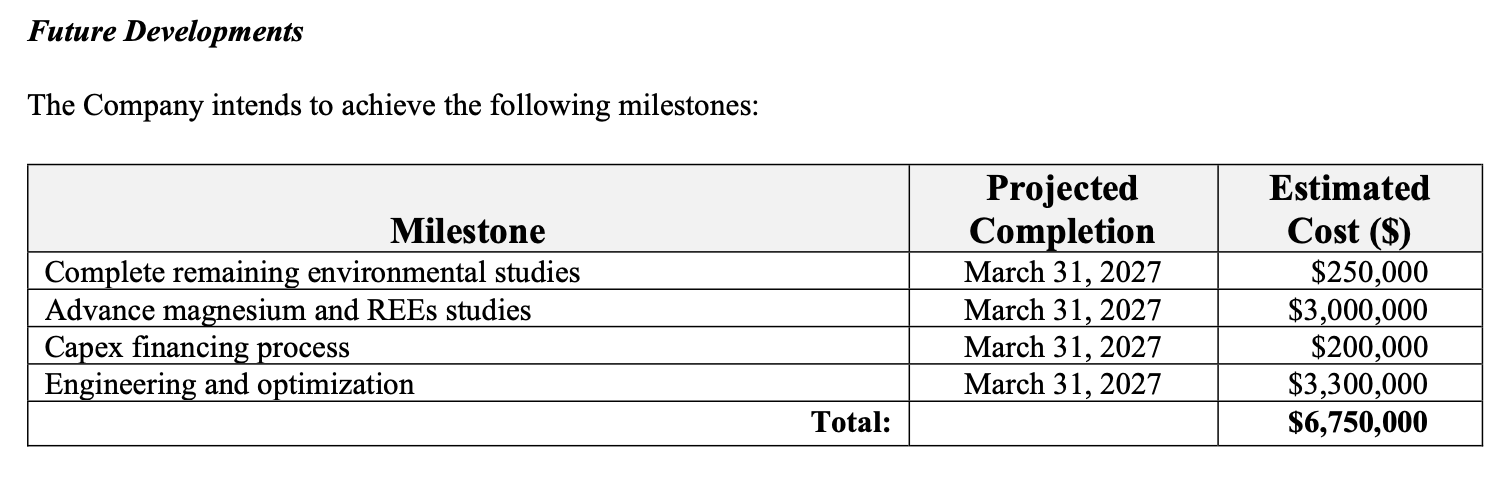
The NRCan grant will support the completion of environmental, magnesium, and REE studies
Seismic
The cooperation now stitched together between Canadian, Greenlandic and European officials is unlike anything a Greenlandic project has carried before, and it sits in near-perfect alignment with Mark Carney's mandate.
“The old order is not coming back. We should not mourn it. Nostalgia is not a strategy. But from the fracture, we can build something better, stronger and more just.”
Mark Carney, Prime Minister of Canada
Mark Carney’s widely praised, standing ovation speech at Davos this January highlighted the importance of the middle powers, to protect their interests in light of a rupture in the world order. Specifically he said “on critical minerals we’re forming buyers clubs anchored in the G7 so the world can diversify from concentrated supply.” Malmbjerg is the embodiment of his doctrine. Carney delivered the speech while Washington was pressuring Denmark to hand over Greenland. A Canadian government putting money behind a Greenlandic-backed moly project is the exact middle-power cooperation he described, aimed at the very territory a great power was trying to acquire.
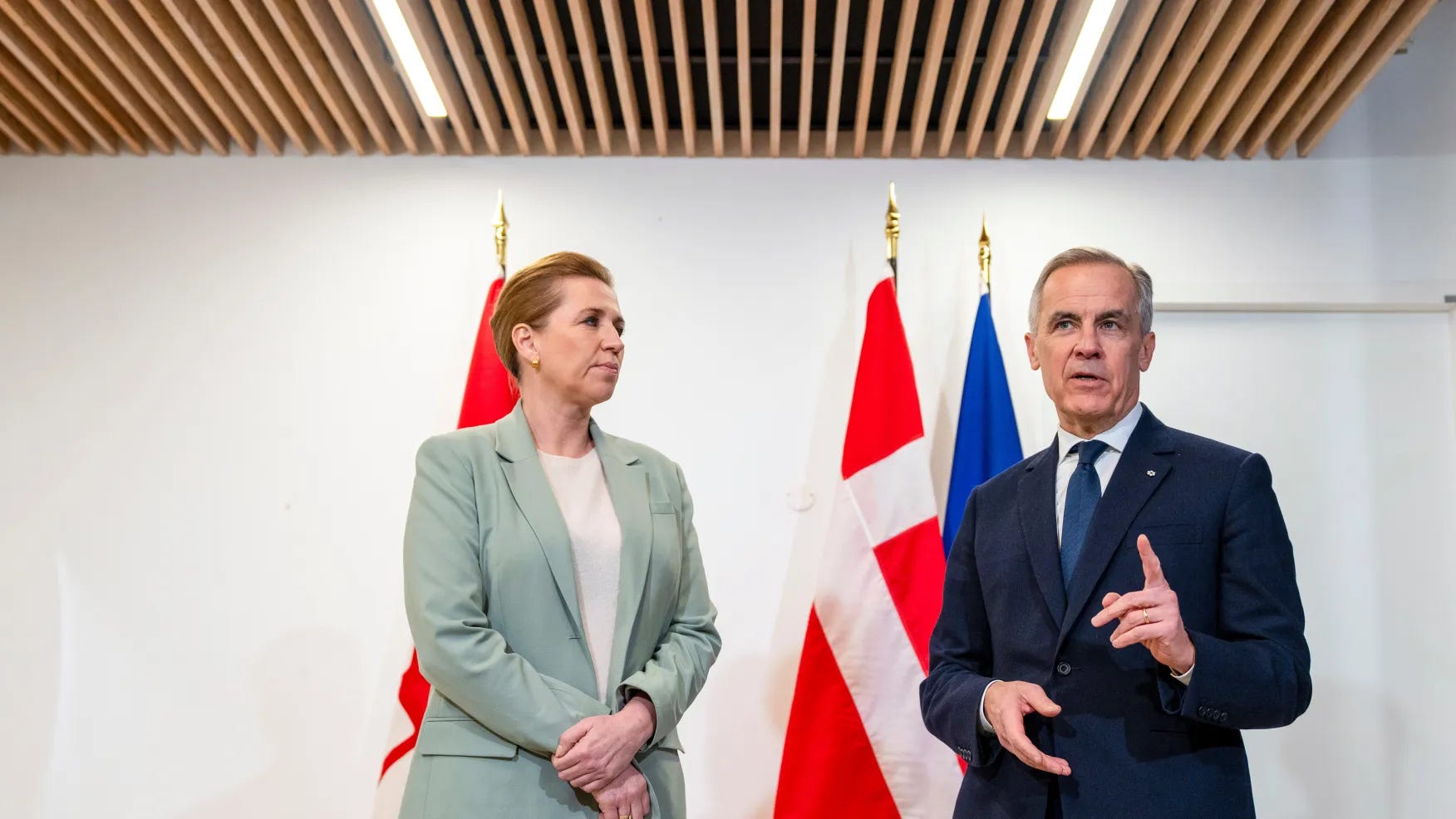
PM Mette Frederiksen and PM Mark Carney
The integration cuts even deeper as Nuna Group Companies, Canada’s largest majority Inuit-owned heavy civil construction firm, will construct Malmbjerg and train the Greenlandic Inuit workforce, drawing on a shared language and culture. It is middle-power solidarity, and Indigenous-to-Indigenous mentorship, which is a large part of why every layer of government has lined up behind the project.
Construction will require more than 500 workers, and operations around 200, drawn primarily from neighbouring communities. The closest is Ittoqqortoormiit, 190 km to the south, one of the most isolated inhabited places in the Arctic, a settlement of a few hundred people with little wage economy beyond fishing. For a community this size, a few hundred stable jobs is a reordering of the local economy.
Beyond the enormous social benefit this project will fulfill, its environmental footprint is uniquely small. Ore moves downhill on a gravity rope conveyor rather than a fleet of diesel trucks. There are no nearby settlements, fishing grounds or animal breeding areas to disturb. And the end use is green on its own: molybdenum is what strengthens the steel in wind turbines and other clean infrastructure.


Gravity Rope Conveyor connecting the open pit mine to the processing facility
Mining can transform a country. Norway is the obvious case: decades of disciplined stewardship of oil and gas wealth turned a modest fishing economy into one of the richest nations on earth. Greenland’s current economy is narrow, propped up by fishing and a Danish block grant that covers roughly a fifth of GDP. Resource wealth, governed well, is the one lever large enough to change that, and over decades Malmbjerg will be where it starts.
The feasibility study projects close to $1 billion in corporate taxes and royalties over the mine's 20-year life. Averaged out, that is on the order of $50 million a year from a single company. There is no exact public figure for Greenland's corporate income tax take, but it is thought to run somewhere between $15 and $30 million annually.1011 Malmbjerg would become Greenland's largest taxpayer by a wide margin. Note the feasibility study is outdated, at current prices today annual revenues and taxes would be materially higher.
Greenland has spent years trying to loosen its reliance on Copenhagen, and the $650 million grant. One mine’s corporate taxes and royalties will not replace that grant, but it is the largest single economic lever the island has. With a projected 22% lift to GDP, hundreds of jobs, and the income tax, it moves Greenland materially closer to the self-sustaining economy its people have said they want.
Greenland will never be part of the USA, no matter what is said in Washington. However, what it does need to do is stand more on its own and bind itself closer to the allies on its doorstep. Over decades, this is the kind of investment that makes Greenlandic sovereignty durable.
Jockey
Through various entities, Ruben owns just over 20% of shares outstanding, about 27 million shares worth north of C$35 million, and he is a persistent open-market buyer on top of that.12 Important for a story like this, as the man running the financings is the man with the most to lose from doing them badly.
His background is capital markets. He was MD of emerging-markets trading at Scotia and VP of trading at TD Securities, and carries three degrees, including a PhD in finance. It's a Carney-shaped résumé: top-tier academic background, I-banking circles, dealmaking. He has done the whole arc before, co-founding Calvista Gold and selling it to the group now inside Mubadala. He is fluent in Danish, which is important not only because the project falls under Danish-Greenlandic jurisdiction, but the operating company itself, Greenland Resources A/S, is a Danish entity.
The circle around him is unusually strong as well. Leonard Asper, who ran CanWest Global is an investor and sits on the board. The company holds an advisory agreement with Rasmussen Global, the firm founded and chaired by Anders Rasmussen, former NATO Secretary General and Prime Minister of Denmark. If anyone can get this mine financed and built, it is Ruben & Co.
The stock currently trades as though the mine will never be built. Liquidity is thin, ~120k shares a day. Of course Moly itself is a very niche and not understood commodity (no retail narrative, no ETF bid the way lithium or uranium gets.) And the opportunity cost narrative also, I think pushes some investors away. Ruben doesn’t promote or market currently, he’s too busy dealmaking right now. Unlike many commodity stories it doesn’t track the commodity closely as well. This may stay cheap(er) longer than it should….I hope it does.
Mining and closure plans are underway and should be completed by EOY when they are due. Closing the equity package will be a huge milestone. The summer field program is in full swing and on track, feeding the pre-construction engineering, and Ruben has been deliberately quiet through diligence. Once he can speak freely, I see the investor base widening considerably.
Re: capital stack, they’re running pretty light, they’ve never rolled the stock, ~135M shares outstanding, w/ minimal stock options/warrants. They had just over C$10M in Cash as of March 2026, since then Canada’s grant has been approved adding at least C$7M to the treasury. No debt.
Value
I won’t publish my model, you should do your own work, come up with your own conclusions. The numbers below are my own base case, which I treat as directionally right rather than precise.
The headline is, this trades as if it has no chance of ever reaching production. My expected value outcome comes out substantially above that scenario.
At spot prices13 I get an NPV814 of US$2.54B (C$3.56B) against roughly a US$1 billion Capex. That is on the order of 0.05x NPV, five cents of price for a dollar of modelled value. In-situ, contained metal after recovery, at spot, makes the molybdenum in the ground worth US$16.5B (C$23.1B).15 Realized revenue ~US$926M/yr through the high-grade first decade, ~US$680M/yr LOM average.16
Yes, there will be dilution, however the dilution should be a scaled-up version of the small EIT RawMaterials deal from November 2025. Capital goes directly into the operating company. This increases the cash and asset value at the subsidiary level first. Because the listed parent (MOLY) owns 100% of the subsidiary, the parent’s overall asset value rises without immediately needing a large issuance of new parent shares. The earlier EIT deal already proved that EU public funding can enter the subsidiary and later be swapped/converted into listed parent shares via put/call options.
What I'll be watching is the terms it gets done at: the implied NPV the round is priced against, and the fraction of that NPV, which under an EIT-style structure is what fixes the conversion price into parent shares. Many holders are anchoring to the previous C$1.65 conversion as a base case, though thinking Ruben does better than that. He's holding the levers too: this equity stake is a small number against the ECA-backed debt already lined up and the off-take book behind it, and it's struck at the subsidiary rather than off the tape. On the €50M, assuming EIT-style conversion, my probabilistic midpoint is around 30% dilution.17
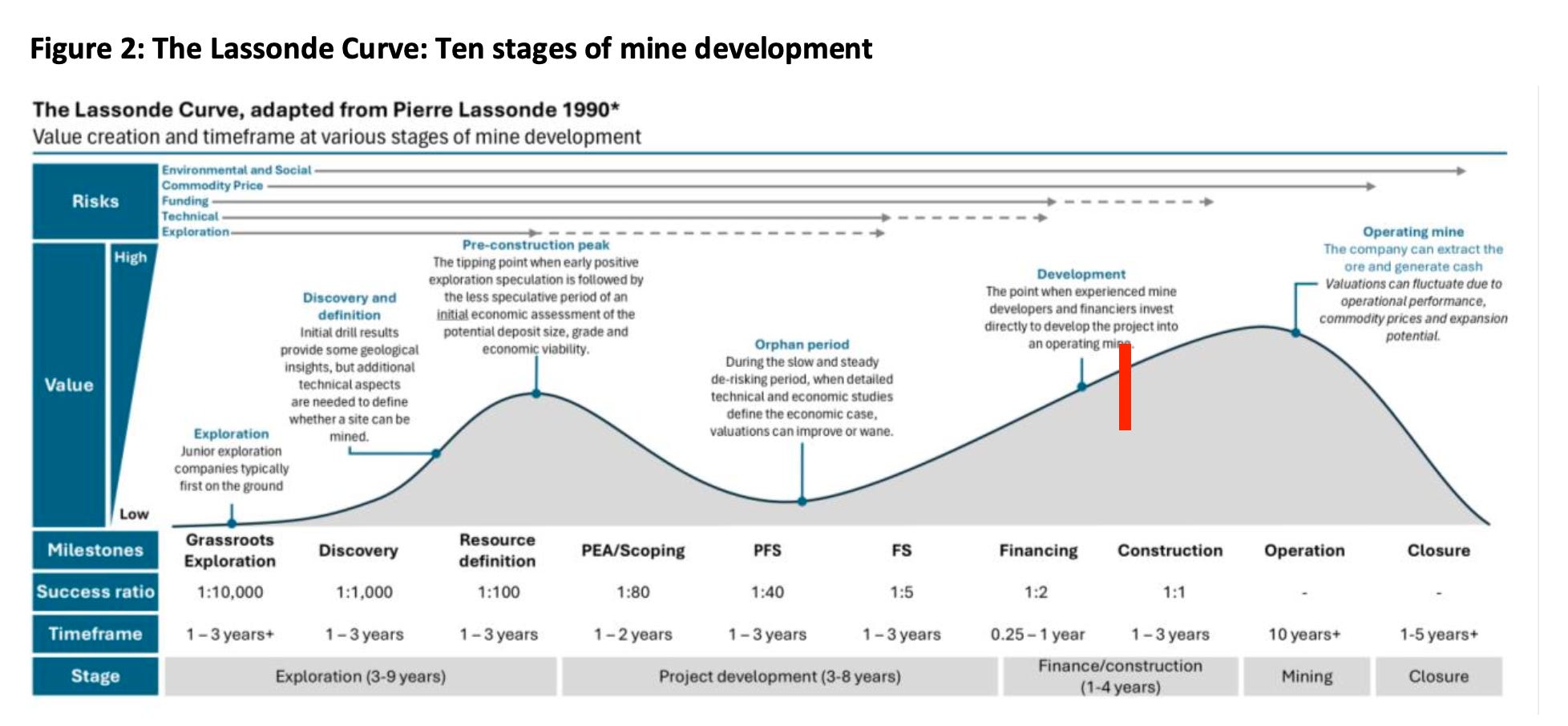
In my view the stock should trade today at no less than 20% of NPV, vs. 5% today, or ~C$5.30. Just as I was finishing writing this, I went through the EIB's recent technical study, and found myself back on the Lassonde Curve, struck by how much this project has been assembled, permitted and financed, yet the share price has lagged that progress, for many of the reasons laid out above. Construction (including ongoing pre-construction) is 4 years, Malmbjerg is expected to be in production in 2030.
Magnesium
Magnesium is central to Malmbjerg's potential, which I've carelessly left out until now. It’s planned as a by-product off two streams: ~35,000 cubic metres a day of saline process water running about 900 ppm magnesium, plus a magnesium fraction carried in the molybdenum concentrate itself. Recovery is being tested now, and the June 2025 exploitation licence Greenland granted covers molybdenum and magnesium together, so the legal right already exists.
This is a further reason for the Carney government’s interest in Malmbjerg that I left out above. Canada imports nearly all the magnesium it uses, because there’s no primary magnesium production in North America, and close to 90% of world supply runs through China. That leaves Canadian aerospace, automotive, defence, and advanced manufacturing badly exposed. The C$7M NRCan grant reads as a molybdenum investment, though I’d argue the magnesium is what Ottawa actually cares about. Europe suffers from a similar exposure, magnesium is on the EU CRMA list, and the continent buys 92% of its consumption from China.18
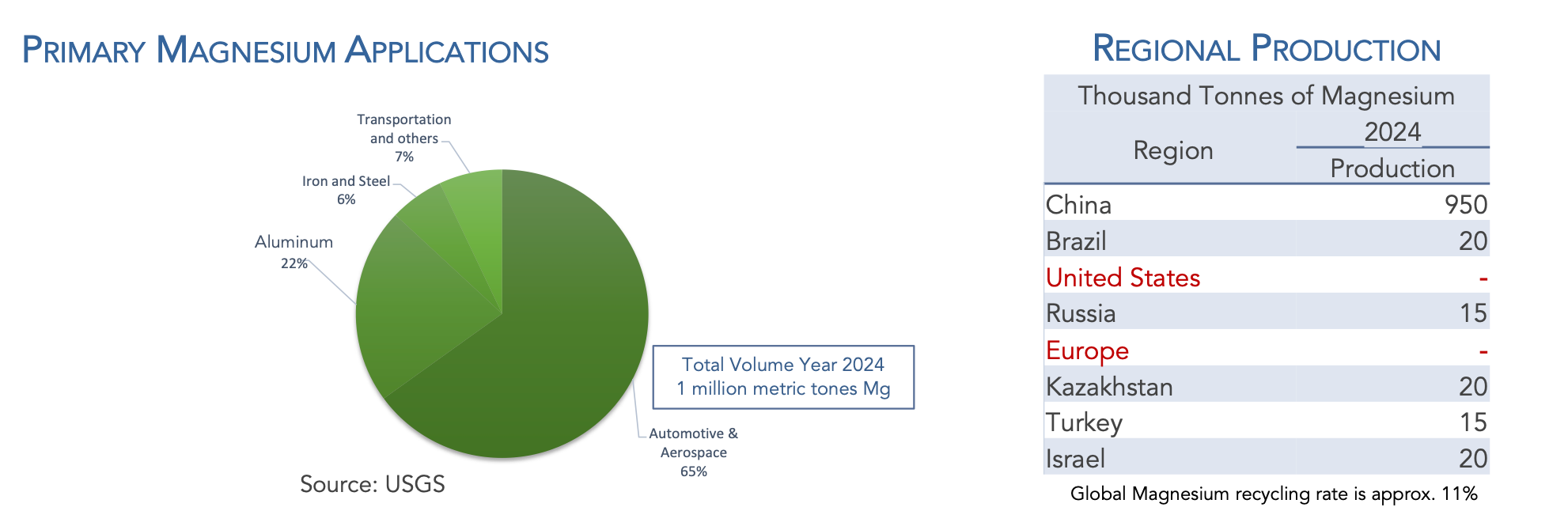
Magnesium Applications and Regional Production (2024)
Optionality
The deposit also carries REEs, including the magnet metals neodymium and praseodymium, and the company is taking a look. How big it plays is unknown, but its right-tail optionality is not baked into anything.
In February 2026, the company expanded its exploration footprint securing exclusive rights to a ~1,147 km² land package surrounding Malmbjerg. This was a 14-fold increase to its size. The scale of this asset continues to swell.
Finally, molybdenum has a growing role in advanced chip manufacturing. Steel consumes the vast majority of mined molybdenum, so semiconductors will never move tonnage…value is the interesting angle. At the leading edge, foundries are turning to molybdenum to replace tungsten in some contact and interconnect layers, where its lower resistance helps at very small dimensions. That pull should grow as sub-2nm gate-all-around fabs ramp. Semiconductor-grade material is a small, high-purity, fast-growing niche that commands a large premium over steel-grade oxide. It won't swing the model, but it's a demand tail with better economics, and one few (if any) molybdenum forecasts price in today.1920
DYODD
for those wanting more on molybdenum to read, a great article
Our World In Data: Which countries have the critical minerals needed for the energy transition? Molybdenum, March 2024
Canadian Mining Report: Greenland Resources and Europe’s Critical Minerals Strategy May 7, 2026
Greenland Resources Presentation
LISTCORP: China Imposes Export Controls on Molybdenum, Feb 2025
Mining.com.au - Molybdenum: Quiet critical metal powering modernity
Greenland is classified as a special territory (OCT) of the European Economic Area, however as Greenlandic people are full EU citizens, it can be thought of as part of the EU
EXIGER - Controls on Five Critical Minerals, February 12, 2025
Canada.ca - Canada secures 30 new critical minerals partnerships and unlocks $12.1 billion in mining project capital
when including roasting, transport and selling
Kalaallit Nunaata Radioa: Overblik: Sådan blev underskud til overskud i landskassen, July 2018
SERMITSIAQ: KNI leverer trecifret millionoverskud - June 2020
Finanzwire - Dr. Ruben Shiffman Increases Stake in Greenland Resources, 2026
Spot Price used was LME $32.61
I deem an 8% discount rate appropriate given the risk/return of the project and underlying commodity. The 2022 feasibility study and most analysts use 6%, which gives the project a valuation above US$3B
In-situ, contained metal after recovery and payability, values the full 571 Mlb reserve at roughly $16.5B at $32.61/lb. Note this covers the entire deposit, while the current 20-year plan schedules about 417 Mlbs of that, worth $13.6B. The balance sits outside the initial mine plan
This is based on the now 4 year old FS, more minerals have been found since, therefore these figures are likely understated
This assumes the €10M and €40M carry the same terms, which may not be the case
Eurostat Statistics Explained: International trade in critical raw materials, June 2026
Entegris Blog: Molybdenum’s Role in Ultra-Fast Computing: The Metal Behind the Speed
MarkNtel Advisors: Molybdenum Market Outlook